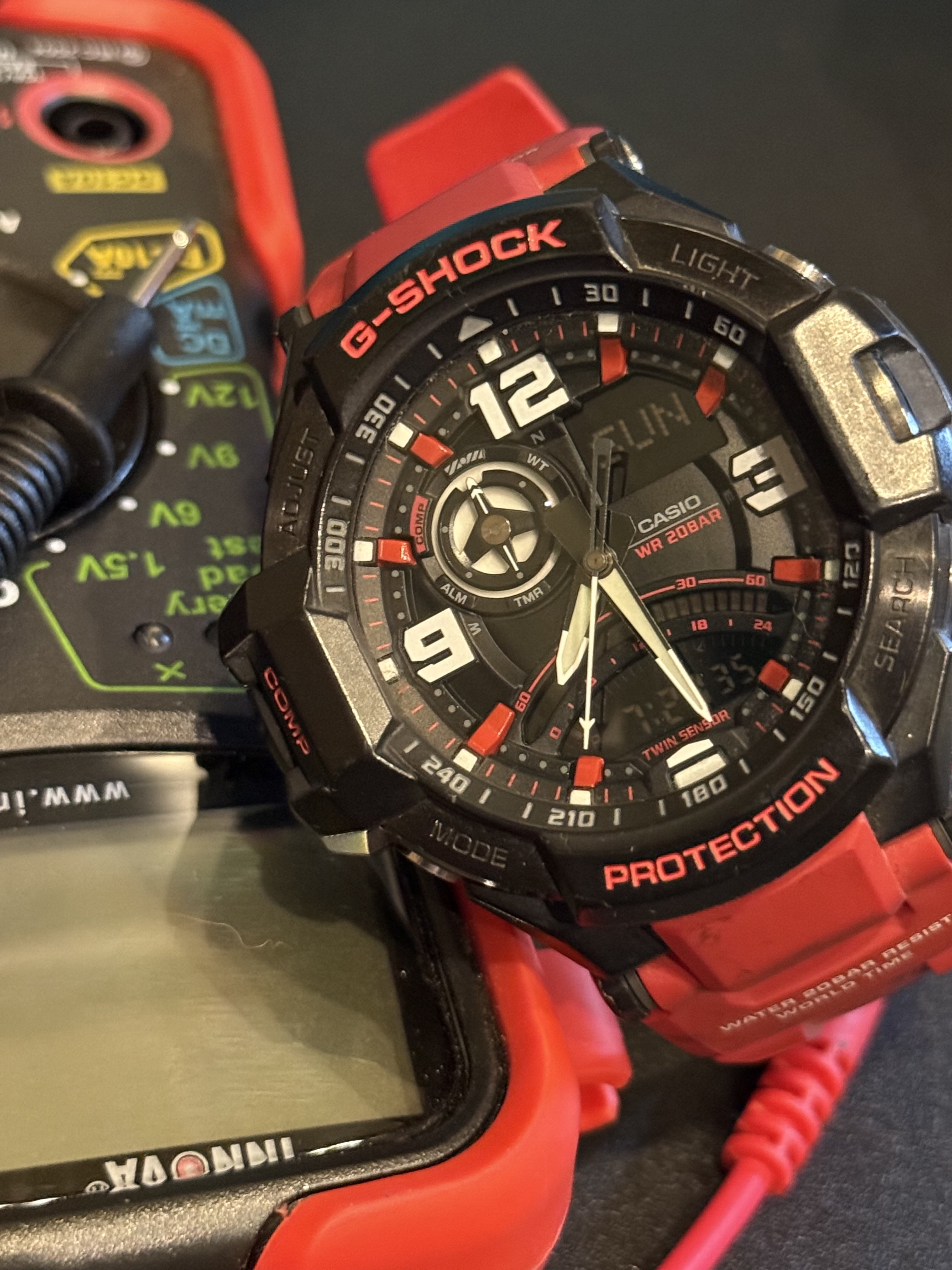
Casio did not build the GA-1000-4B for minimalists. This watch lands on the wrist as a piece of equipment. The case spans about 52.1mm across, stands 16.9mm thick, and yet keeps the weight to a surprisingly manageable 88 grams thanks to its resin-heavy construction. Casio placed it in the Master of G-Air Gravitymaster family and released this reference in 2014, which fits the watch perfectly: it looks like a mid-2010s idea of aviation toughness turned all the way up.

I really like the color. The black case, red resin, red accents, negative digital displays, and oversized white numerals give the watch real contrast and real discipline. It looks loud, but not messy. The watch has presence from every angle, and it never fades into the background.

Part of the appeal comes from how much Casio stuffed into the design without letting readability collapse. You get analog-digital timekeeping, a proper running seconds hand, world time across 31 time zones and 48 cities, a 1/100-second stopwatch, countdown timer, five alarms, a thermometer, and a digital compass with bearing memory. In compass mode, the second hand points north, while the displays handle direction and angle data. That functional overload could have made the GA-1000-4B unreadable. Casio got away with it because the large numerals and thick hands do their job.

That second hand deserves special mention. It changes the personality of the watch. A lot of G-Shocks project toughness through bulk, screens, and button guards. This one still does that, but the running seconds hand adds motion and gives the dial a more instrument-like feel. Casio also uses that hand as part of the compass system, which makes it more than decoration. That choice helps the GA-1000 line stand apart inside the broader G-Shock world.

The nighttime effect also comes off as more thoughtful than gimmicky. Casio’s Neon Illuminator uses a blacklight LED, and the company says the coating on the second-hand tip and minute markers reacts to that light, while the hour and minute hands and insets continue glowing afterward through Neo-Brite treatment. Our camera makes this effect look stronger than it appears to the naked eye. Even so, the result still looks excellent, and more important, it feels distinctive.

Casio marketed it toward aviator-style use, and the direct-access compass button at 9 o’clock shows that the tool-watch story was not an afterthought. Press once, jump straight into compass mode, and the watch gives 20 seconds of continuous directional reading. Most owners will never need that in daily life, but that hardly matters. G-Shock often works best when Casio overbuilds the solution. The utility here runs well past ordinary need, but that surplus capability forms part of the charm. This is a bad ass watch and that’s fun.

On the wrist, the GA-1000-4B wears better than the raw dimensions suggest. The 52mm watch feels usable rather than punishing. This is a large watch, no question. Still, it does not carry the dead heft of a big steel diver. It wears more like a serious piece of resin equipment than a wrist anchor.

As a style object, this one has range that many big G-Shocks never find. Jeans and a black T-shirt obviously work. Casual outerwear works. Night-out use works. I would not call it dressy in any conventional sense, but with the right attitude, I can even see it against a dark suit as a deliberate act of contrast. Not subtle. Not classic. Effective anyway. This watch does not ask permission.

This example also shows why pre-owned G-Shocks can appeal so much. The caseback carries visible scratching, the strap shows normal wear and some transfer marks, and there is light grime or residue around a few of the recesses and edges. None of that undercuts the watch. If anything, it suits the model. The GA-1000-4B looks like a machine that expects use, not pampering. The bold color still pops, the dial furniture still reads clearly, and the overall package still feels coherent.
The deeper reason I like this watch comes down to Casio’s old strength: purposeful over-engineering at a democratic price point. Shockbase lists the original U.S. price at $250, and for that money Casio gave buyers 200 meters of water resistance, shock resistance, compass and thermometer functions, mineral/spherical glass, multi-time-zone capability, and one of the more visually animated dials in the G-Shock catalog. That is a lot of watch, even before the styling enters the conversation. The watch’s rarity and popularity have kept prices for used pieces about that new price.

I would not call the GA-1000-4B refined, but it is what I would successful. It looks aggressive without falling apart visually. It offers real function without becoming a cluttered mess. It wears large without wearing heavy. And in this red-and-black version, it delivers something a lot of tool watches never manage: actual fun.

For me, that is the point. The Casio G-Shock GA-1000-4B does far more than most people need, looks far bolder than most people require, and wins precisely because of both.
Leave a Reply