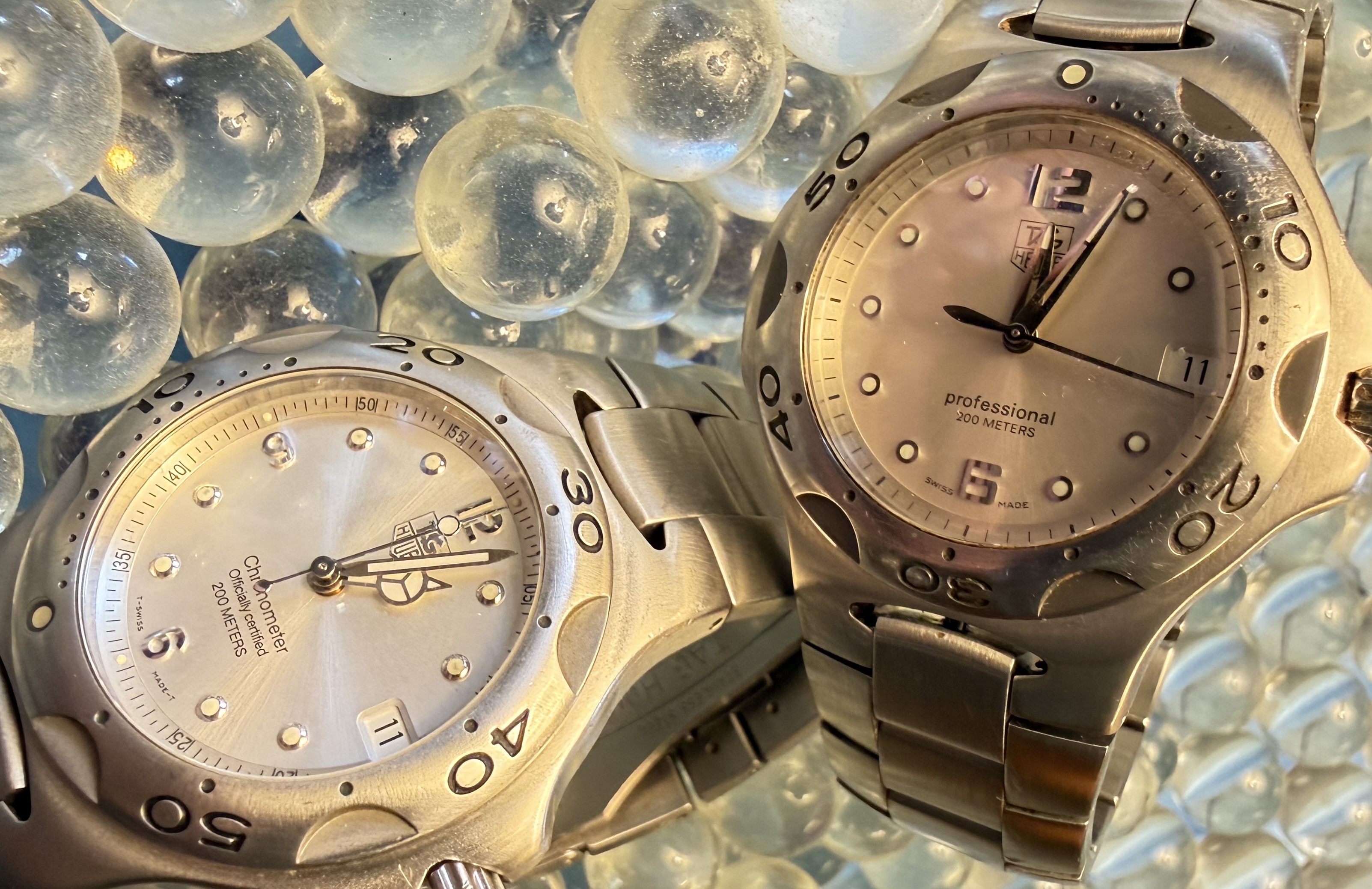
Sometimes the used watch market gives older designs room to breathe again. Watches that may look unusual, even out of step with current trends, back into focus once enough time has passed. That is exactly what happens with the TAG Heuer Kirium.
The Kirium is not built around the oversized proportions that dominate much of today’s market. These two examples, the quartz WL111E and the automatic chronometer WL5110, sit closer to 37 mm at their narrowest point and about 39 mm across the crown-guard area. On paper that sounds modest. On the wrist, though, both watches feel substantial, sleek, and very complete.

What stands out immediately is the case shape. The Kirium has a kind of late-1990s, early-2000s futurism that still looks distinctive today. The lines are rounded, flowing, and a little architectural, but not heavy. There is a slimness to the design that gives the watches a refined, deco elegance. They do not wear like thick modern sports watches, and they do not need to. They sit flat, feel balanced, and manage to dress up or down without much effort.

Versatility is a large part of the appeal.
The two watches also show how much personality can come from small differences within the same design language. The quartz WL111E is the simpler and more restrained of the pair. The dial is clean, legible, and understated, and the overall impression is one of quiet confidence. The automatic WL5110, by contrast, carries a little more weight in the enthusiast imagination because it adds COSC chronometer certification and a mechanical movement to the same elegant Kirium case.

From a historical standpoint, the automatic has the earlier roots. The silver WL5110 configuration appears in TAG Heuer catalogue material by 1999, with the bracelet version WL5110.BA0700 documented in 2001. The silver quartz WL111E.BA0700 arrives later, appearing in the 2004 catalogue. That makes these watches close relatives, but not exact contemporaries.

The movement story is also worth noting. The automatic WL5110 is regularly identified in dealer and pre-owned listings as using an ETA 2892-2, which makes sense given the watch’s thinness, smooth wearing character, and chronometer specification. TAG Heuer’s later Calibre 7 designation belongs to the same ETA 2892 / Sellita SW300 family, but we did not find a period source that clearly labels this exact Kirium reference as “Calibre 7,” so we’re guessing this is an ETA 2892-2-based chronometer automatic.
The quartz WL111E is a little less straightforward. Again, we did not find a reliable official source tying that exact reference to a named calibre. The strongest evidence we found points to ETA 955.112, which is the movement repeatedly associated with men’s Kirium quartz service parts and Kirium watchmaker discussions.

In practical terms, both watches succeed for the same reason: they are easy to wear. The brushed finish is well judged, the bracelet has real substance, and the watches feel more expensive than many used pieces in their current price range. The clasp is serviceable rather than exceptional, but it works, and the overall package still feels cohesive. There is enough heft to remind you that these are proper Swiss-made TAG Heuers, but not so much that they feel cumbersome or outdated.
That is where the used market becomes especially interesting.

As of March 2026, WatchCharts places the WL111E around the mid-$300 range, with a market range roughly from the high-$200s into the low-$400s. The WL5110 automatic sits higher, around the mid-$400s, with a market range that can stretch into the mid-$500s depending on condition and sale data. Current Chrono24 asking prices broadly support that spread, with WL111E examples around the mid-$400s and WL5110 examples commonly advertised from roughly $400 into the $500s.
That pricing matters because it puts both watches in a very interesting place. Neither one is cheap in the way a throwaway quartz watch is cheap, but both offer an accessible way into a widely recognized luxury brand without forcing the buyer into current retail pricing. In the automatic WL5110 especially, there is a strong argument that you are getting a surprisingly sophisticated watch for the money: COSC certification, a respected ETA automatic base, 200-meter rating, and a case design that still looks unlike almost anything else on the market.

The quartz WL111E makes a different kind of case. It shows how good a used quartz TAG Heuer can be when the design is strong. It tells good time, wears elegantly, and avoids feeling like a compromise. In fact, for many buyers, the quartz version may be the better everyday proposition. It gives you the same Kirium silhouette, the same silver-dial minimalism, and the same wrist presence in a simpler, lower-maintenance package.

Taken together, these two Kiriums make a persuasive argument for older used TAG Heuer watches generally. They remind you that the used market is not just about saving money. It is also about recovering designs that no longer have direct equivalents in the modern catalog. The Kirium belongs to that category. It is recognizably TAG Heuer, recognizably of its era, and still distinctive enough to draw attention now.
That is not something every used watch can say.
Leave a Reply