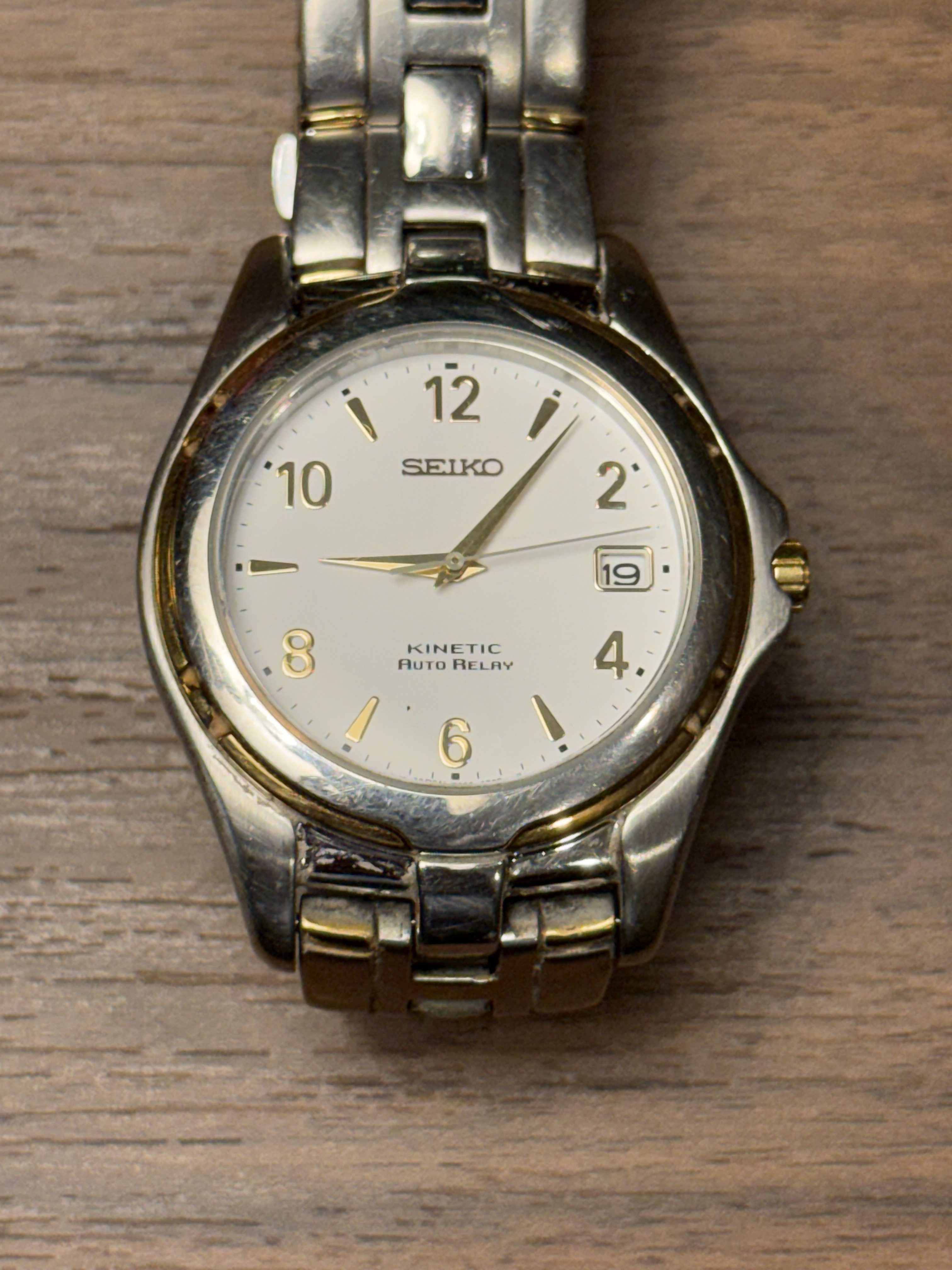
This Seiko Kinetic Auto Relay lands in a category I tend to like: watches with a genuinely interesting idea behind them, packaged in a format that still feels easy to wear. It looks familiar, wears comfortably, and then quietly reveals that it operates very differently from a standard quartz piece.

At 39mm, this example hits a sweet spot. On the wrist, it reads as medium-sized in the best way—substantial enough to avoid feeling slight, restrained enough to wear with almost anything. The case has enough mass to feel like a real steel Seiko, but not so much that it drags on the wrist over a long day. That balance gives the watch broad range. It can sit under a cuff, handle regular office wear, and still feel natural with jeans, loafers, or a weekend jacket.

The design leans late-1990s to early-2000s Seiko: rounded case, soft integrated lines, and two-tone detailing that adds warmth without turning the watch flashy. I like the way the gold accents stay contained. You get gold at the bezel edge, crown, dial furniture, and bracelet accents, but the watch remains mostly a steel watch. A fully gold-tone piece would push it toward dress-only use. This one stays more flexible.

The dial helps a lot. White dials can look flat when the printing or furniture feels cheap. That does not happen here. The applied Arabic numerals at the even hours add shape, and the mixed use of numerals and tapered markers gives the dial enough structure to avoid looking generic. The handset stays sharp and legible. Nothing dramatic, nothing overdesigned. This was never supposed to win on ornament. It wins on clarity.
Up close, the watch shows its age honestly. The crystal has visible scratches, especially in stronger light. The case and bracelet show normal wear as well, with surface marks and rubbing consistent with use. None of that ruins the watch. In a way, it fits the point of a Kinetic Seiko. These were built for everyday ownership, not precious storage. A used example like this should show some life.

The bracelet deserves a little attention too. Seiko gave this reference a signed bracelet that matches the case well and keeps the whole watch visually coherent. The links have enough contour to avoid the stamped, throwaway feel that cheaper older quartz pieces often carry. On the wrist, that translates into comfort. It also helps the watch present as a complete original package rather than a nice head on a mediocre bracelet.

The movement is the real story. Caliber 5J22 is a Kinetic Auto Relay movement: an analog quartz caliber with Seiko’s automatic generating system, powered by wrist motion and storing that energy in what Seiko calls the Kinetic Electricity Storage Unit. In the technical guide, Seiko lists the movement as 13 jewels, with a titanium lithium-ion rechargeable battery, accuracy rated at less than 15 seconds per month in normal temperatures.

Seiko’s own history page traces Kinetic back to the 1988 A.G.S. breakthrough, and Seiko’s Kinetic knowledge page notes that Kinetic Auto Relay arrived in 1998. Time+Tide places the Auto Relay upgrade in the 1999 wave of improvements and describes exactly why collectors still remember it: it solved the annoying dead-in-the-drawer problem in a way ordinary quartz and ordinary automatic watches did not.

I also think this watch shows why Seiko’s Kinetic project mattered. It was not just “quartz, but different.” Seiko was trying to combine quartz accuracy with a more mechanical ownership experience—motion, stored energy, no routine disposable battery changes, and a sense that the watch remained physically connected to the wearer. Seiko still defines Kinetic as a system in which wrist motion drives an internal generator and the electricity is stored in a rechargeable battery that needs replacement less frequently than a conventional quartz cell.

That brings us to the capacitor—or, more precisely in Seiko’s own language here, the energy storage unit / rechargeable cell. For an older Kinetic, that part becomes the key service point. This example has a new capacitor installed. A fresh storage unit gives the watch back the feature that makes the movement interesting in the first place: useful reserve, proper wake-up behavior, and freedom from the tired, half-functional state that so many older Kinetics fall into. Seiko’s service center still describes movement service for quartz calibers as including replacement of a battery, ion cell, or rechargeable battery as needed, which tells you this remains a real maintenance consideration in ownership.

One small technical quirk adds to the charm and the weirdness. The time relay function restores the hands to the stored time, but it does not automatically correct the date. If the watch has spent long enough asleep for the calendar to fall behind, you may need to reset the date manually. That is exactly the sort of detail enthusiasts tend to enjoy: not because it is perfect, but because it reminds you that this was a very specific engineering solution to a very specific problem.

In real use, I can picture this watch in a lot of settings. It works as an office watch for someone who wants something more interesting than a plain department-store quartz dress piece. It works as a travel watch because the dial stays clean and the movement stays practical. It works as a daily grab-and-go option for someone who likes older Seikos but does not want the full maintenance profile of a mechanical watch. The 39mm case helps all of that. It gives the watch enough presence for modern tastes without losing the compact discipline older Seikos usually got right.

I also think the used-market value looks good here. If you compare this to a lot of low-cost used quartz dress watches, this one has much more character and much better movement architecture. If you compare it to pricier Swiss quartz options, it may not win on prestige, but it brings a more distinctive ownership experience. And if you compare it to ordinary older automatics in the same price range, the Kinetic Auto Relay movement gives you a technical talking point most of them simply do not have.

My final take: this reference succeeds because it does not need hype. The design stays clean. The size stays useful. The movement stays unusual in a way that still feels relevant. Add the new capacitor, and you remove the biggest practical objection that many older Kinetics carry.

I would not call it a watch for everyone. Some people will always prefer a straightforward automatic or a dead-simple battery quartz. But for someone who likes Seiko history, appreciates transitional technology, and wants a comfortable 39mm daily wearer with more depth than a standard dress quartz, this 5J22-0869 has real appeal.
Leave a Reply