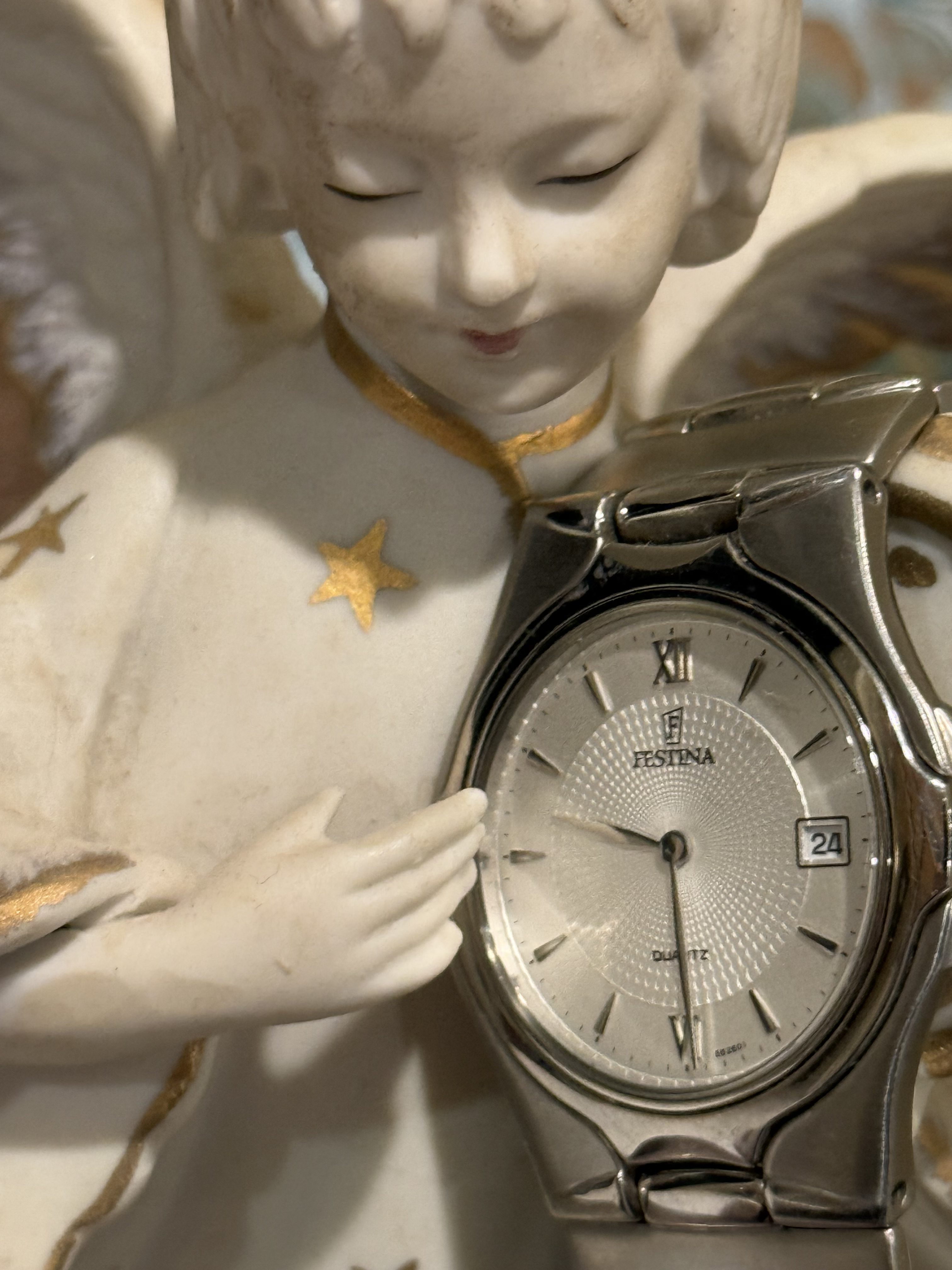
I like watches like this Festina 6626-01 because they do not need much noise to make their point. On paper, it is a fairly simple piece: a quartz dress watch in stainless steel, listed at 36 mm, with a date window, mineral crystal, and integrated steel bracelet. In practice, though, it has more personality than a bare specification sheet would suggest, and most of that comes from proportion, restraint, and a dial that is much more interesting than it first appears.

The dial is the part that kept drawing me back. From a distance it reads as a clean silver dress dial, but the closer view tells a better story. The center has a radiating textured pattern that gives it a guilloché-like effect, while the outer ring stays calmer and lets the applied markers, Roman numerals at 12 and 6, and framed date window at 3 do their work. It is a small composition, but a thoughtful one. The result is elegant without becoming precious. A plain silver dial can go dead very quickly. This one does not.

I also like the case and bracelet architecture. The integrated bracelet and flowing case shoulders give the watch a very cohesive look, almost as if the whole thing was drawn in one pass instead of assembled from unrelated parts. That continuity helps explain why the watch feels genuinely unisex to me. At 36 mm, it avoids both the shrunken fragility that can make some smaller dress watches feel fussy and the oversize posture that ruins the point of a refined piece. It just wears like a neat, balanced steel watch that could land comfortably on a lot of wrists and in a lot of wardrobes. The lightness you mentioned fits the design well. This is not trying to impress through mass. It is trying to win on shape, proportion, and finish.

There is also something satisfying about the way this one reflects what Festina has long done well. The company began in 1902 in La Chaux-de-Fonds, Switzerland, later moved to Barcelona after a change in ownership, and entered a new phase after Miguel Rodríguez acquired the brand in 1984. Over time, Festina built a strong international presence and became closely associated with accessible European watchmaking, especially through its sports and cycling ties. That broader history does not turn every Festina into a major collectible event, nor should it, but it does give context to a watch like this. It comes from a real, long-running watch firm rather than from one of the many makers that produce forgettable dress watches by the thousands.

What I find appealing here is that the watch feels well made without trying to advertise that fact too loudly. The steel case and bracelet have the solid, straightforward quality I want in a used dress watch, even if this particular example would benefit from a bit of polishing. The bracelet and case show the light surface wear that tends to come with honest use, and the photos make that plain, but the watch still presents cleanly because the underlying design is strong. A weaker design starts to look tired as soon as wear appears. This one still looks composed.

That combination of honest wear and lasting elegance is part of why I think used watches are often more interesting than new ones. A watch like this does not need hype, and it does not need a long technical pitch. It simply offers a handsome silver dial, sensible sizing, an easy steel bracelet, and the kind of understated style that works with almost anything. It could sit under a cuff, disappear into everyday office wear, or serve as a minimalist dress watch without asking for much attention. In a market full of pieces that strain to look important, I find that sort of calm far more convincing.

We have this example available in our eBay store here.
Leave a Reply